Meshtastic vs GMRS vs Ham Radio: Choosing the Right Tool for Reliable Communication
When people start thinking seriously about backup communication, they almost immediately run into a confusing decision:
Should I use Meshtastic, GMRS, or ham radio?
Each option has strengths. Each has limitations. And none of them are interchangeable once you understand what they’re designed to do.
This guide exists to cut through the noise and help you choose the right tool for your actual use case, not the loudest recommendation online.
The Most Important Thing to Understand First
There is no “best” communication system.
There is only:
- The right tool for the job
- And the wrong expectations for a given tool
Most frustration comes from using a system outside its design envelope.
Overview: Three Very Different Approaches
At a high level:
- Meshtastic = decentralized messaging
- GMRS = short-range voice with optional repeaters
- Ham radio = maximum flexibility with maximum responsibility
Let’s break each one down honestly.
Meshtastic (Mesh Radio Communication)
Meshtastic is an open-source mesh communication system built on low-power radios that communicate directly with each other.
Using Meshtastic, devices form a decentralized network where messages hop from node to node without relying on towers, repeaters, or internet access.
Strengths
- No license required
- No subscriptions or monthly fees
- No central infrastructure
- Works quietly in the background
- Excellent for local and regional coordination
- Pairs with phones for easy use
- Extremely power efficient
Limitations
- Primarily text-based messaging
- Range depends on terrain and node placement
- Not designed for nationwide communication
- Not real-time voice
Best Use Cases
- Cellular outage backup
- Neighborhood or ranch coordination
- Family and mutual-aid communication
- Off-grid or rural environments
- Situations where infrastructure independence matters
Meshtastic excels when simplicity, resilience, and decentralization are more important than raw distance.
GMRS (General Mobile Radio Service)
GMRS is a licensed personal radio service designed primarily for voice communication over short to medium distances.
Strengths
- Simple voice communication
- No technical exam required
- License covers immediate family
- Widely available radios
- Can use repeaters where available
Limitations
- License required (even if no test)
- Range is limited without repeaters
- Repeaters are centralized points of failure
- Voice-only (no native messaging)
- Higher power consumption
Best Use Cases
- Family vehicle convoys
- Short-range voice communication
- Areas with reliable repeater access
- Users who prefer voice over messaging
GMRS works well when infrastructure exists and voice communication is the priority.
Ham Radio (Amateur Radio)
Ham radio is the most flexible and powerful option—but also the most complex.
Strengths
- Massive range of frequencies and modes
- Voice, data, and digital communication
- Can reach long distances under the right conditions
- Strong emergency and volunteer ecosystem
Limitations
- License and exam required
- Steep learning curve
- More complex equipment
- Higher expectations of operator knowledge
- Often overkill for simple local coordination
Best Use Cases
- Emergency communications volunteers
- Long-distance communication
- Technically inclined users
- Experimentation and learning
- Situations requiring maximum flexibility
Ham radio rewards investment—but it demands it as well.
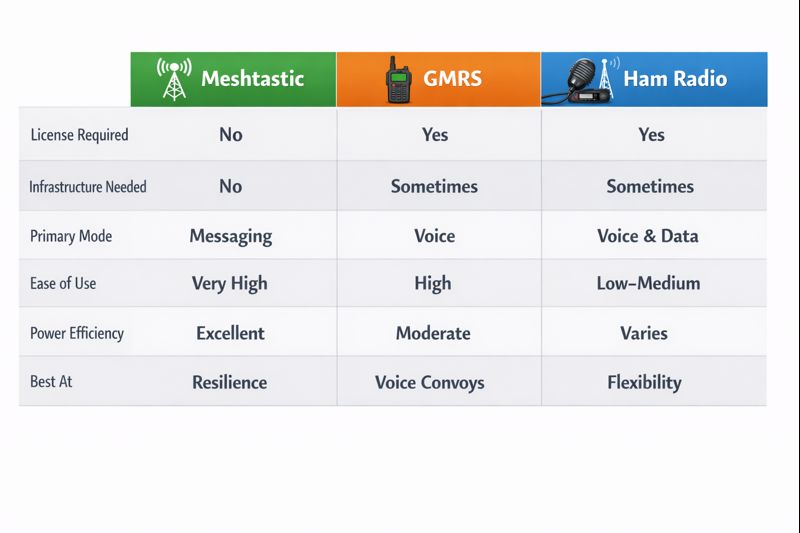
Side-by-Side Comparison
Why Many People Choose the Wrong Tool
The most common mistake is asking:
“Which one is better?”
Instead of:
“What problem am I trying to solve?”
If your concern is:
- Cellular outages
- Local coordination
- Low power usage
- Independence from infrastructure
Then Meshtastic is often the cleanest and least fragile solution.
If your priority is:
- Live voice
- Vehicle-to-vehicle communication
- Existing repeater coverage
GMRS may make sense.
If you want:
- Maximum capability
- Long-distance reach
- Technical depth
Ham radio is unmatched.
Layered Communication Is the Real Answer
Professionals don’t choose one system.
They layer them.
- Cellular when it works
- Mesh when it doesn’t
- Voice radio when needed
- Long-range options when available
Mesh communication fits naturally into this layered model because it:
- Requires no licensing
- Runs quietly in the background
- Doesn’t compete with other systems
- Continues working when centralized systems fail
The Practical Takeaway
Meshtastic isn’t trying to replace GMRS or ham radio.
It fills a gap those systems don’t address well:
- Simple, resilient, infrastructure-independent messaging
If your goal is communication that keeps working when assumptions fail, mesh belongs in your toolkit.
Ready to get started?
Explore our pre-configured kits designed for real-world use.